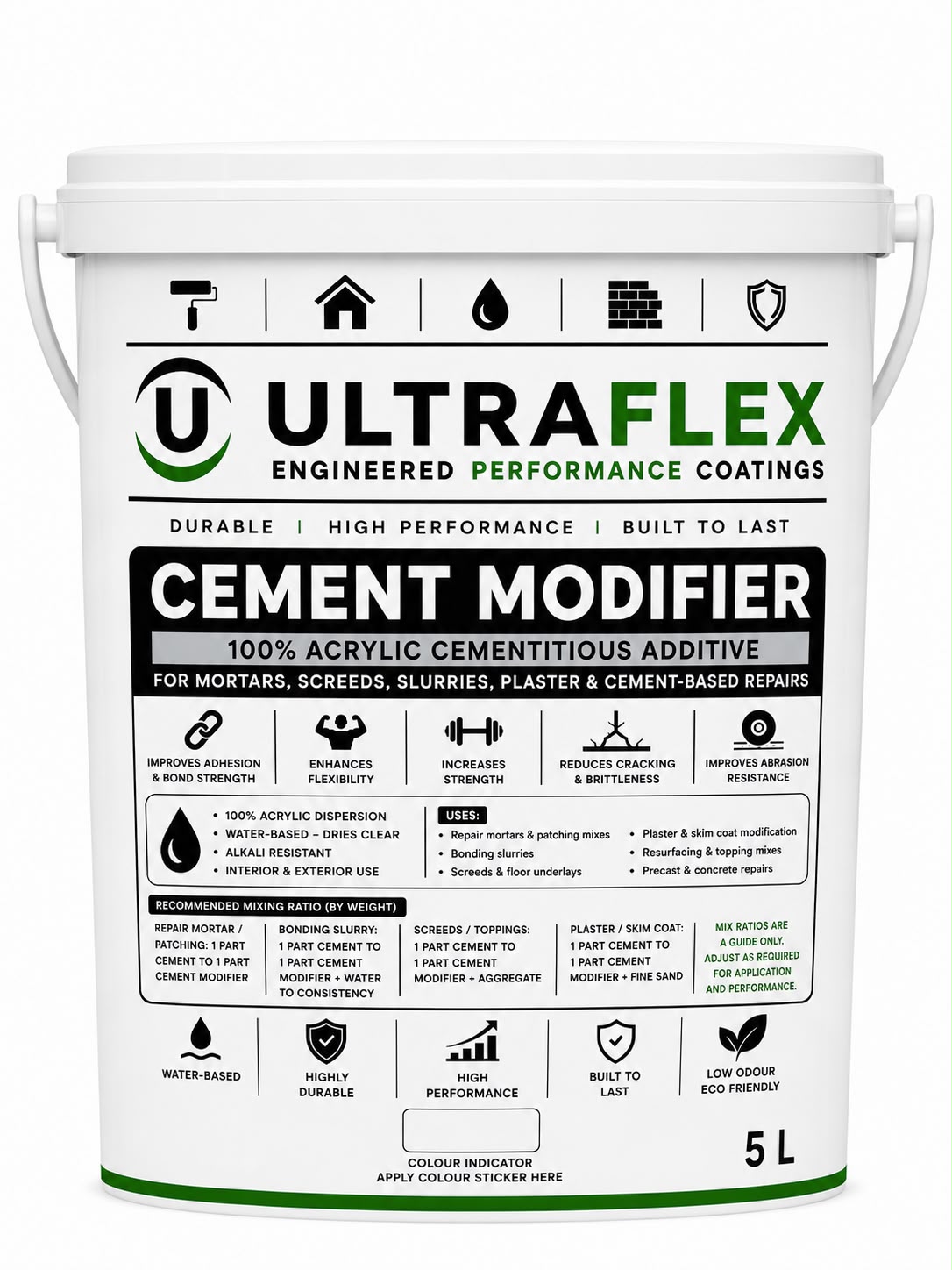
100% Acrylic Cementitious Additive
For Mortars, Screeds, Slurries, Plaster and Cement-Based Repairs
UltraFlex Cement Modifier is a water-based, 100% acrylic additive developed specifically for modifying
cement-based products.
When incorporated into compatible cementitious mixes, it helps improve adhesion, flexibility, strength and
resistance to cracking and abrasion.
Cement Modifier is suitable for professional construction, repair and resurfacing applications where improved
performance is required from mortars, screeds, slurries, plaster and cement-based repair compounds.
KEY BENEFITS
• 100% acrylic cementitious additive
• Water-based formulation
• Improves adhesion and bond strength
• Enhances flexibility
• Helps reduce cracking and brittleness
• Improves impact resistance
• Improves abrasion resistance
• Enhances durability
• Suitable for interior and exterior applications
• Suitable for new construction and repair work
• Easy to incorporate into compatible cement-based mixes
• Professional contractor-focused product
SUITABLE APPLICATIONS
UltraFlex Cement Modifier may be used in compatible cement-based systems such as:
• Repair mortars
• Patching compounds
• Cement slurries
• Bonding slurries
• Screeds
• Floor underlays
• Plaster mixes
• Skim-coat mixes
• Resurfacing compounds
• Cementitious waterproofing mixes
• Precast cement products
• Concrete and masonry repairs
• General cement-based construction applications
The correct dosage and mixing method must be selected according to the specific application and system
requirements.
PRODUCT APPEARANCE
Cement Modifier is supplied as a water-based acrylic liquid intended to be incorporated into compatible
cementitious systems.
It is not intended for use as a final decorative coating.
The appearance of the finished mix will depend on the cement, aggregate, fillers, pigments and other
materials used in the complete formulation.
PERFORMANCE BENEFITS
When correctly used in an approved cementitious formulation, Cement Modifier can help improve:
ADHESION
Promotes stronger bonding to correctly prepared concrete, masonry and cement-based substrates.
FLEXIBILITY
Helps reduce brittleness and allows the finished cementitious system to better accommodate normal
movement.
STRENGTH
Can improve the overall mechanical performance of compatible mortars, screeds and repair compounds.
CRACK RESISTANCE
Helps reduce shrinkage-related cracking and surface brittleness when used as part of a properly designed
mix.
ABRASION RESISTANCE
Improves resistance to wear in suitable cementitious resurfacing and repair applications.
DURABILITY
Enhances the long-term performance of correctly formulated and applied cement-based systems.
SURFACE PREPARATION
Before applying a cementitious system modified with UltraFlex Cement Modifier:
• Remove dust, dirt, grease, oil and surface contamination.
• Remove loose, weak or friable concrete and masonry.
• Remove poorly adhering coatings and failed repairs.
• Mechanically prepare smooth or dense surfaces where required.
• Repair structural cracks and major defects separately.
• Ensure the substrate is sound and suitable for the intended application.
• Pre-dampen absorbent cementitious surfaces where required by the system specification.
• Remove standing water before applying the modified mix.
• Confirm that the substrate and proposed formulation are compatible.
Cement Modifier cannot compensate for unstable substrates, poor mix design, structural movement or
inadequate preparation.
MIXING
Cement Modifier must be thoroughly incorporated into the liquid portion of the selected cementitious
formulation before or during mixing, according to the approved application instructions.
The correct dosage will depend on:
• The intended application
• Cement content
• Aggregate grading
• Required flexibility
• Required adhesion
• Required strength
• Application thickness
• Exposure conditions
• The complete system design
Do not use one general mixing ratio for every application.
The applicable Technical Data Sheet, system guide or project specification must be followed.
APPLICATION
The modified cementitious mix may be applied using methods appropriate to the selected system, including:
• Brush application for compatible slurries
• Trowel application
• Float application
• Screed application
• Patching and repair methods
• Suitable specialist application equipment
Mix only the quantity that can be applied within the workable period of the cementitious system.
Apply the material evenly and compact or finish it according to the requirements of the application.
CURING
Correct curing remains essential to the performance of cement-based products, even when modified with
acrylic technology.
The finished application should be protected from:
• Rapid moisture loss
• Strong wind
• Direct heat
• Rain during early cure
• Frost
• Premature traffic or loading
• Excessive movement before sufficient strength has developed
Curing requirements will depend on the complete cementitious formulation and project conditions.
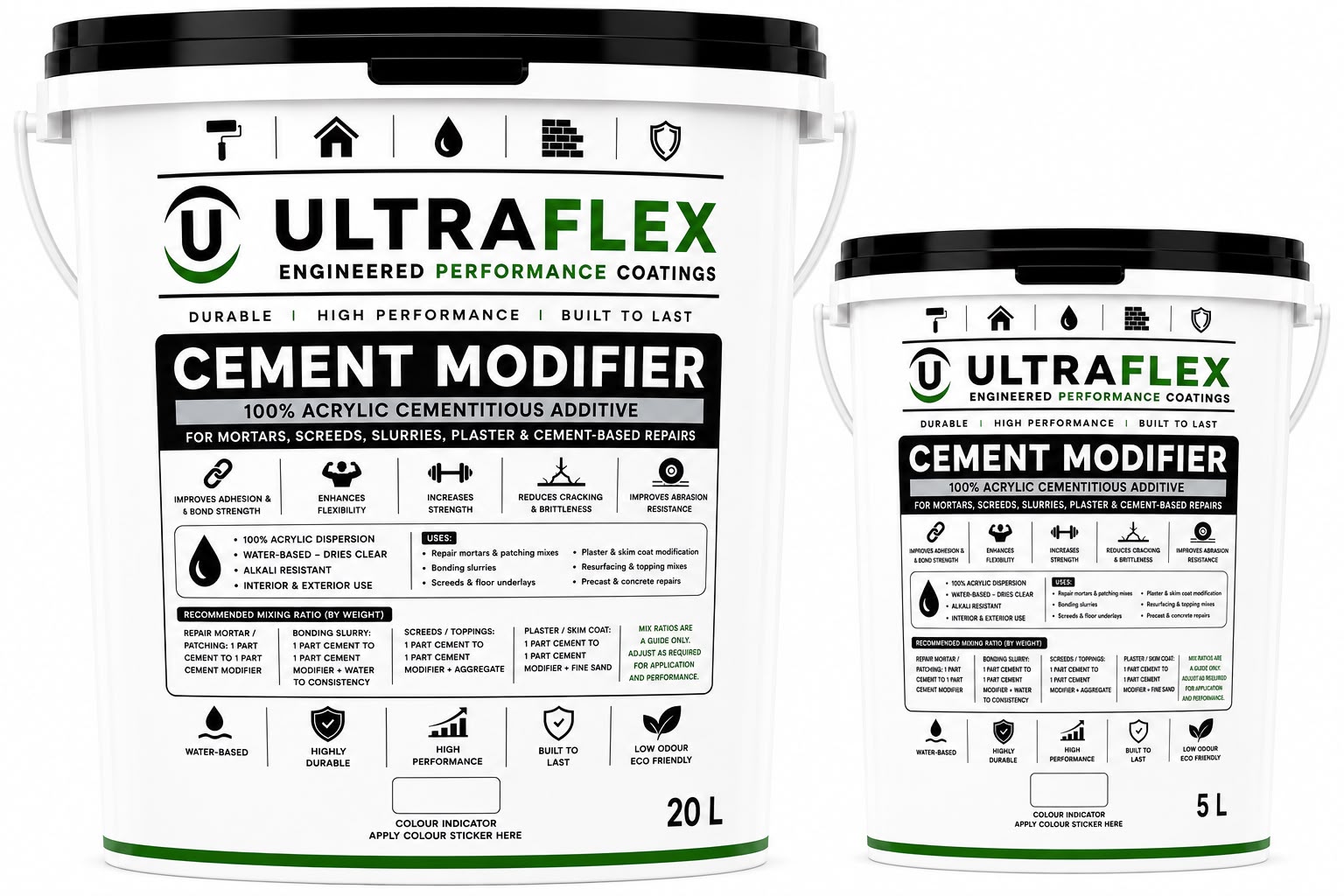
AVAILABLE PACK SIZES
• 20 L
• 5 L
Pack selection should be based on the required project quantity and the approved dosage for the intended
cementitious system.
COVERAGE
Cement Modifier is an additive and does not have one universal spread rate.
The quantity required depends on:
• The selected mixing ratio
• Cement content
• Application type
• Layer thickness
• Project area
• The complete formulation
Project quantities should be calculated according to the approved system or mix design.
IMPORTANT LIMITATIONS
• Do not use as a standalone decorative coating.
• Do not apply directly over dirty, oily, loose or unstable substrates.
• Do not use one mixing ratio for all cementitious applications.
• Do not exceed or reduce the specified dosage without technical approval.
• Do not use Cement Modifier as a substitute for correct cement, aggregate or water proportions.
• Do not apply over structural movement without suitable repair.
• Do not add excessive water to improve workability.
• Protect the finished application during curing.
• Performance depends on the complete formulation, preparation, application and curing process.
• Trial mixes should be completed where the proposed formulation or application has not previously
been approved.
• Store the product under suitable conditions and protect it from freezing or excessive heat.